Showing posts with label death. Show all posts

Tuesday, October 30, 2012

Prayers for the Dead

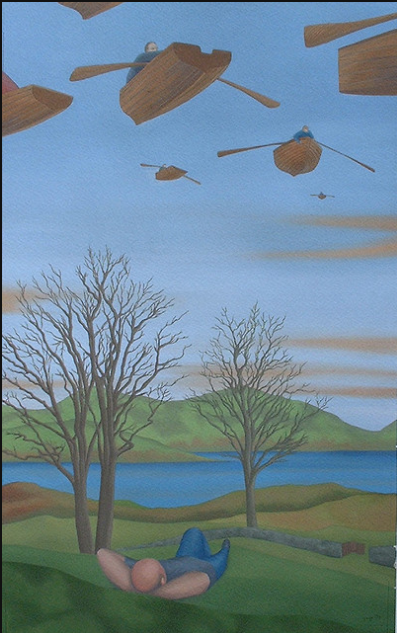
"Rowing Slowly Through Eternity" by Anthea


The dead are always looking down on us, they say.
while we are putting on our shoes or making a sandwich,
they are looking down through the glass bottom boats of heaven
as they row themselves slowly through eternity.
They watch the tops of our heads moving below on earth,
and when we lie down in a field or on a couch,
drugged perhaps by the hum of a long afternoon,
they think we are looking back at them,
which makes them lift their oars and fall silent
and wait, like parents, for us to close our eyes.

That’s good old Billy Collins. The imagery makes me smile. I sometimes wonder about the dead and about the relationship between those who breathe light and those of us who are still inhaling oxygen. Halloween is tomorrow. All Hallows’ Eve. I remember last year seeing a small mass of slightly-older-than-my children running freely and costumed across the grass in a yard in our neighborhood on their way to ask for candy. It was a quintessential scene of childhood. While there’s much that’s unsavory about the way some celebrate the night, there’s so much that can be beautiful about Halloween. Illuminating smiling, carved gourds. Small heroes and princesses, animals and ninjas padding from house to house receiving kindnesses in the form of small edible things.

The holiday has its roots in Samhain, the Gaelic harvest festival which usually takes place on the night directly between the autumnal equinox and the winter solstice, the threshold opening onto the dark half of the year. It is traditionally a night of liminality, in which the veil separating this world from the Otherworld is opened and the dead can visit this mortal sphere. An intermingling of the seen and unseen worlds. I learned this from a humanities professor who specialized in medieval cathedral architecture. The class was called “Framing the Sacred,” an interesting notion, I think. How do you frame the eternal and unbounded in artwork or literature or liturgy? These were the questions we studied. She took our class to the Cathedral of the Madeleine in Salt Lake City one All Saints’ Day. As the choir music rained upon us and raised itself to the stained-glass cherubim circling our heads, I felt the veil thin.

My wife sits at the computer with my eternity-eyed infant daughter in her lap, typing names. Each name is a prayer of sorts—a testimony of Jesus Christ’s infinite, unbounded mercy—and of the role we play in grace. These names, gathered like blueberries from the bushes of old censuses and city records, will be carried with gentle care into holy temples and spoken with affectionate reverence, sweetness on the tongue. Prayers for the dead. “Else what shall they do which are baptized for the dead, if the dead rise not at all?” asked Paul, “Why are they then baptized for the dead?” This in the middle of a discourse on the triumph of life over death, the energetic reality of resurrection: “Death is swallowed up in victory. O death, where is thy sting? O grave, where is thy victory? . . . But thanks be to God, which giveth us the victory through our Lord Jesus Christ. Therefore, my beloved brethren, be ye stedfast, unmoveable, always abounding in the work of the Lord, forasmuch as ye know that your labour is not in vain in the Lord.”

Almost all religions that affirm the eternality of the soul offer prayers in behalf of the dead, to keep them in remembrance, to ask special protective care as they enter that bright unknown. Catholics perform masses and offer prayers for the dead. Jews offer Kaddish—the prayer of making holy. There is a lovely Jewish prayer of mourning, memorial, and obsecration called El Molai Rachamim: “God, filled with mercy, dwelling in the heavens’ heights, bring proper rest beneath the wings of your Shechinah, amid the ranks of the holy and the pure, illuminating like the brilliance of the skies the souls of our beloved and our blameless who went to their eternal place of rest. May You who are the source of mercy shelter them beneath Your wings eternally, and bind their souls among the living, that they may rest in peace. And let us say: Amen.” The Shechinah is the radiant cloud of God’s presence. What a nice place to rest.

Like so many others, members of my church believe perhaps paradoxically that death is not the end of living and that every life matters. Our way of offering prayers for the dead is to perform sacred ordinances on their behalf. We are baptized for the dead, immersed in water in the name of someone who has crossed over the expansive river of death. There is a physicality to the prayer, a heft and a weight. There is a sheer loveliness to it. It is a sanctifying experience to stand in another’s shoes as it were to receive the ordinances of salvation. I often imagine the people whose names are read with such affection sitting near me, or floating above me. Sometimes I imagine them laughing at the prospects and possibility opened up to them through these ordinances. Sometimes I imagine tears of joy and gratitude. Once when I received the ordinances for a long line of men from Italy, I could almost smell the spaghetti and hear their warm, excited voices. Perhaps it is only my imagination. Perhaps not.

Joseph Smith once wrote of the practice, “And now, my dearly beloved brethren and sisters, let me assure you that these are principles in relation to the dead and the living that cannot be lightly passed over, as pertaining to our salvation. For their salvation is necessary and essential to our salvation, as Paul says concerning the fathers—that they without us cannot be made perfect—neither can we without our dead be made perfect.” I’ve thought often about those words “neither can we without our dead be made perfect.” My soft-spoken mission president once told me that “the salvation of a soul always requires the sacrifice of another.” He said that for all humanity, that sacrifice was the Savior, but that each of us is called upon to give of ourselves, to extend ourselves, to offer our time and our energy and our love to bring another to grace. This is what happens in the temple. Christ’s was the great vicarious sacrifice, but unless I become like Him and empty myself out for the blessing and benefit of others, neither I nor they can be saved.

These ordinances take place in temples. The temple is a liminal space, halfway between heaven and earth. What happens there conjoins the worlds. The late, gentle, Swedish Lutheran, Krister Stendahl, who in his lifetime was Dean of Divinity at Harvard University, once said of Mormon temple worship, “In antiquity, . . . the Jerusalem Temple was a place where you went to carry out holy acts, sacrifices and the like. I feel that the Mormon experience of the temple has sort of restored that meaning to the word temple.” Stendahl was a thoughtful, lovely soul. Of baptisms for the dead, which his church does not practice, he said, “It’s a beautiful thing. I could think of myself as taking part in such an act, extending the blessings that have come to me in and through Jesus Christ. That’s a beautiful way of letting the eternal mix into the temporal — which, in a way, is what Christianity is about.” He speaks of “holy envy,” saying if we might speak of such a thing, he has holy envy for the Mormon temple experience. What a nice thing to say.

In September of 1842, Joseph Smith was living in hiding from the infamous Missouri governor Lilburn Boggs, who had it out for the Mormon prophet. He spent much of his time in the space between the rafters and the roof of Edward Hunter’s house in Nauvoo, Illinois. In this setting, he wrote some gorgeous lines about salvation for the dead. Truman Madsen calls it “a rhapsody in an attic.” If poets are the minor prophets, Joseph belongs to both camps, major and minor. Here are his words:

Now, what do we hear in the gospel which we have received? A voice of gladness! A voice of mercy from heaven; and a voice of truth out of the earth; glad tidings for the dead; a voice of gladness for the living and the dead; glad tidings of great joy.

Let your hearts rejoice, and be exceedingly glad. Let the earth break forth into singing. Let the dead speak forth anthems of eternal praise to the King Immanuel, who hath ordained, before the world was, that which would enable us to redeem them out of their prison; for the prisoners shall go free.

 Let the mountains shout for joy, and all ye valleys cry aloud; and all ye seas and dry lands tell the wonders of your Eternal King! And ye rivers, and brooks, and rills, flow down with gladness. Let the woods and all the trees of the field praise the Lord; and ye solid rocks weep for joy! And let the sun, moon, and the morning stars sing together, and let all the sons of God shout for joy! And let the eternal creations declare his name forever and ever! And again I say, how glorious is the voice we hear from heaven, proclaiming in our ears, glory, and salvation, and honor, and immortality, and eternal life; kingdoms, principalities, and powers!

The temple is a house of poetry, of imagery and spirit and symbolism and beauty, like Emily Dickinson’s house of Possibility. It affirms the great mystical connectedness of humanity, of all hallowed ones, all saints, all souls. We matter to each other. This life matters to eternity. I always leave the temple more in love and more appreciative of this dark green living, this golden-bright autumn day.

Sunday, October 7, 2012

The Water's Edge


Friday night I held Eleanor’s small, perfect, pajama-clothed body against me to warm her and to be warmed by her as we stood outside on a rooftop and listened to human beings pour music out of their insides and out of their (mostly stringed) instruments. Ellie watched wide-eyed and happy. She cooed and sang and I felt her small head vibrate under my warm hands which perched atop her head in the attitude of blessing, covering her ears to muffle the sound and offering what heat or fire I could. The songs they sang were mostly about light and water. The water ones washed around my thoughts:

Now Jordan’s banks they’re red and muddy,
And the rolling water is wide.
But I got no boat, so I’ll be good and muddy,
When I get to the other side.

And when I pass through the pearly gate,
Will my gown be gold instead?

How many times did ancient Israelites cross the river Jordan into a new life, an unknown? Joshua’s priests, hoping against hope that this swelling spring river would stop when the soles of their feet hit the wetness. As a heap. Those priests carrying their precious ark got a little wet, a small splash on the robes, but the others passed over dry-shod to the unknown of those high walls of Jericho. A new life. Utterly different from the wilderness they had just left. Of course, their fathers had passed through the waters as well. From slavery to freedom. From relative comfort to uncertainty, too. And Elijah crossed that same river to board his chariot of fire, off to a life of certain light. A new and different ministry. But he left behind poor Elisha to pick up the mantle and cross back—lonely, confused, uncertain. He walked into a world of miracles, though. They usually did. And then the Savior walked into that river a carpenter’s obedient Son and walked out the very Son of God. Well, or so it seemed to His mystified neighbors.

And there was this song: Wade in the water. Wade in the water, children. God’s gonna trouble the water.

A man sat by the pool of Bethesda—the pool of the house of mercy—waiting for an angel to trouble the waters. Troubled waters bring healing. But the waters came to him. A woman sat by a well, cracked like the worn jar in her hands. The Son of God said to her, “If thou knewest the gift of God, and who it is that saith to thee, Give me to drink; thou wouldest have asked of him, and he would have given thee living water.” How? You have nothing to draw with. “Whosoever drinketh of the water that I shall give him shall never thirst; but the water that I shall give him shall be in him a well of water springing up into everlasting life.” This woman spoke with the embodiment of Living Waters. The waters had come to seep into and soothe her broken soul. “Give me this water.”

So, then, just this: Maybe the water meant so much because I had come to that music from the baptism of a student of mine—a bright, glistering, good young woman who has waited a long time for this. It was good for us to be there. Baptism is a death and a birth at the same time. Every crossing of the waters is. “Know ye not, that so many of us as were baptized into Jesus Christ were baptized into his death?” But this burial is into life itself, not in earth or under stone, but we are immersed in water, enveloped in life. “Therefore we are buried with him by baptism into death: that like as Christ was raised up from the dead by the glory of the Father, even so we also should walk in newness of life.” Newness of life. “I am come that they might have life, and that they might have it more abundantly.” To die into living waters and to emerge transformed. The very air is different.

I don’t know the quality of life we will enjoy in the next world, but I feel somewhat certain that it will be life “coupled with eternal glory, which glory we do not now enjoy.” There will likely exist certain parallels between this life and that—for life is life. But we will glow. We will know. Life elevated. Death will be a birth into a newness of life. Resurrection always follows a passing away.

So, too, I suppose that the quality of Shain’s life will change dramatically after being immersed in that font of living water. She will breathe differently. When she came mewling into this world and screamed her first breath of mortal air, she began to experience something unparalleled in her existence. From the light of God into this diffused, slanted earthly light. But now embodied. Able to hold a hand and to hug a friend. To smell the wispy fresh-washed hair of an infant. That former life surely held its glories. But without dying to that life, I could never have experienced this.

For the past two days, I have bathed in a flow of Spirit and words. I love living apostles and prophets. My heart has hummed and sung and glowed. This new life. This new life.

When I was born, I was given a new name and a family. Every birth provides these gifts. My name identifies, distinguishes, and associates me. Shain too received a new name at baptism. She took upon her the name of Jesus—distinguished from the darkness of the world by her new relationship with the Light of the World and associated with the fellowship of the Saints. This is a family of open arms. She will stumble as she begins to walk in newness of life. She will stutter as she speaks with the new tongue—the tongue of angels. But she will grow up in this new life. She has come to the water’s edge. And she has crossed. I have come to the water’s edge now several times. Every crossing brings death, cleansing, and a resurrection to newness.

Sunday, September 23, 2012

Prayers

"Heralding Angels" by Annie Henrie


Prayers for Rory, whose brother died Friday and who found out while he was in my classroom. Who seemed so lonely and sad and confused and my words failed. Prayers for the two babies and the wife of that brother, who found themselves widowed and fatherless and who must be, must be,  in the special providential care of the Father of all.

Prayers for Michael who told Rory that he worries every minute of every day that his father will be killed in Afghanistan but that he has learned to trust that death is not something to fear. Death is not the end, it is the beginning. Death is a great, bright adventure. We should not be afraid of death.

Prayers for Lorina who told Rory that three of her siblings died by the time she was twelve. When her six-year-old sister died when she was twelve, she saw her little brother and sister who had gone on before come to recover her and take her into a world of light. Who still feels their presences and thinks of their faces and wonders and hopes.

Prayers for Andre whose mother and father died in a car crash when he was a small boy and who was adopted, along with his four siblings, by his aunt and uncle who already had six small children of their own. Who began hating his aunt-mother when he was a young teenager and felt that his own mother would not be so demanding and his life would have been much better if she had not died but who eventually tried to serve and love her and realized she is a marvelous, beautiful woman. I really love her, he said. Who told us all this a week ago and who asked if he could maybe offer a prayer for Rory. He prayed for courage and hope and comfort and strength.

And prayers for all the rest of those bright, beautiful, broken kids who wept with and for Rory and who are fighting demons and devils and darkness of their own. Prayers for this world in which horrible things happen and people shine with a light so resplendent it makes you wince in agonizing love.

Thursday, June 28, 2012

Mystery and Communion


Paul insisted that we see through a glass darkly. I recently saw a picture of an old Roman mirror. It looked like a frying pan. Almost no reflection, no gleam. But one day something like scales will fall from our eyes and we will see as we are seen and know as we are known. That’s a promise, and one fraught with vivid hope for me. Communion can seem fairly elusive in a world in which every person is a mystery. Sometimes it feels like we love and interact and hardly even know each other, barely brushing spirit shoulders with these luminous beings which surround us on every side.

Certainly, I believe that communion is possible; I have experienced it from time to time—that sort of mutual understanding that surpasses words. On a bench in the temple just before my wife and I were married. When laughing with another person at some shared humor. In moments of joint gratitude.  Or singing hymns; I have looked around on more than one occasion with a sort of shock to realize that all these people with all these different lives are singing the same words and (roughly) the same melody, our breath and prayers intermingling, weaving themselves into a sort of mystical brilliance that lingers for a moment in the air above our heads.

But I live so often in the world of my own thoughts that I have been startled on more than one occasion to look over at a passing car on the freeway to find someone looking back at me. Our eyes meet for an instant, and I realize, “I don’t know you. I probably will never know you. But you woke up today inside your mind, and your life matters to you as desperately as mine matters to me.” And then we will speed off to our various destinations; within minutes I am consumed by whatever is occupying my mind, the center of my own universe.

I have often longed to know a person better. My own children are mysteries to me. I sometimes go into their rooms to watch them sleep, wondering, “Who are you?”

My grandmother passed away early yesterday morning. I had a hard time sleeping the night before, knowing it was coming. She was one of the sweetest, gentlest, most patient, longsuffering humans I ever met. And I loved her, admired her, named my daughter after her. They say that when you get old and sick your façade crumbles and you are left with the real you, the essential, core soul of you. Often people become irritable or discourteous when they lose their filters. But my grandma became more serene, more pleasant. She had strokes for years and years and gently endured it with a quiet smile. As my cousin and I talked at the poolside where our kids splashed and screamed yesterday afternoon, it hit me that I didn’t really know my grandma. I spent a good deal of time at her house and remember her giving me cinnamon flavored chewing gum as a child. I have distinct, colorful memories of her home and of her lemon tree and her backyard. But she was always just a presence, my grandma, kind and generous and soft. I didn’t have the wisdom as a child see her as a person, with real feelings and a life of her own, dreams and adventures and failures and heartbreak. She was Lutheran until she met my grandfather. She thought he’d make a good Lutheran. She made a great Mormon. She was a hostess, a social hub in her southern California ward. She loved the outdoors. And, I don’t really know what else. I am sort of excited to go to her funeral to hear the old stories from those who knew her best, but even so I imagine she’ll sit smiling on the other side of the veil, listening and realizing that no one really knew her.

But one day I will walk through that veil. The veil will be rent, just as it was when Jesus died. And something will give. Mysteries will be revealed. I will know. I will know people. In some ways, I can’t wait. In others, I am glad to delight for the time being in the holy mysteriousness of my wife and children, of my grandfather (whom I would like to get to know better), of all these walking enigmas whom I love but may never really know in life.


(The picture is "Woman With Infant Flying" by Brian Kershisnik)

Friday, June 15, 2012

Do they mingle?


“Never lose a holy curiosity,” urged Albert Einstein. I like that thought and the posture of humility and awe it inspires in the face of existence. I sat today in the back seat of a car with a budding astrophysicist talking about string theory and dark energy and dark matter—these potential hiding places of the divine in the expanding universe, the location where God and his holy angels may well conceal all their mass for all we know or can observe. I smiled, thinking of Annie Dillard’s statement that since Heisenberg, many physicists now are “a bunch of wild-eyed, raving mystics.” A holy curiosity: an affirmation that life is mysterious, and that the mystery is wonderful and the quest of questioning is fruitful even if answers are not found.
One question that has rolled around my soul for years and which brings me pleasure to wonder at came to me one Memorial Day in a cemetery in Provo. My wife was pregnant with our first child, and I was full of eager anticipation. We were there to visit her grandfather who had fairly recently passed away. We watched a young girl in the distance running with flowers. There’s something about a young girl running. A series of fragmented thoughts came to me: “Do they mingle—the spirit worlds? I can’t wait to have a daughter running through a graveyard toward a grandfather she never knew in this life. But knew. And will.” I wondered if my yet-unborn daughter knew my wife’s grandfather—if Bri was tenderly tutoring Lydia about the beauty of mortality. I knew—or sensed, at least—that she knew me and was somehow aware of my life, that that veil was somewhat thin. She had visited me in a dream when I was fifteen and charged me with a sense of expectation of the loveliness of a future fatherhood. And I knew what Brigham taught about the postmortal spirit world being right here, on earth, with those who have passed on possessing a knowledge of us and our hopes and concerns and fears. But do the worlds of spirits have communion one with the other? Do the premortal hosts have access to the postmortal ghosts? Do the as-yet-unembodied dance with the disembodied? Do they speak? Is there any embrace or a common space?
I think I’ve wondered about this in part because my own grandfather died just a few weeks before I was born. I always wished I knew him. I dreamed of him and Jesus when I was a toddler. My father was in his early twenties—a young father with one young son and a young pregnant wife—when his dad died. He still had younger siblings living at home. My mother says the grief of that loss shook my father to the core of his being. I interviewed him about it as part of a college class assignment when I was in my early twenties. It hit me then that my dad was just a boy when his father walked across the veil into a light unknown to us on this side. And that my father was human and could hurt. We wept together, and he told me that my birth was a source of healing in the wake of his father’s passing—that my existence came like a sort of phoenix rising from the ashes left by the brightness of a well-lived life. My dad told me I have my grandfather’s laugh and his sense of humor. They gave me his name as my middle name. Did I speak with him in those days between his exit from this green planet and my entrance? Is there something his in me? I like to think so. But I don’t know. We certainly knew each other when the morning stars sang together and all the sons of God shouted for joy. Before it all began. We were together then, brothers. And again we will be. In the meantime, there’s room for holy curiosity.