Showing posts with label names. Show all posts

Saturday, May 10, 2014

It Was Mom

"Climbing Mother" by Brian Kershisnik


Here’s a tribute to my mother: Santa Teresa La Tranquila. I wish I could remember sitting in her sacred lap, sucking my finger as she showed me the magic of books, of words, of stories. I wish I could hear again the songs she sang into my sleeping spirit. My mother is one of the gentle ones. Santa Teresa de la Exquisita Caridad.

She taught me that charity never fails. True love overcomes all things and is everything. It is the it of it all. Love is the real deal. She loves people, all people. You see it in her dancing brown eyes when you meet her and she takes your name into her mouth and tastes the essence of it and never forgets it. Names are sacred for her, not as a source of power, but as a source of connection, of affection. She used to have every phone number in our neighborhood memorized, so she could call out her kindness at the hint of a whisper of need.

One day when I had grown into a lanky, surly teenager, I tried to throw my father down the stairs. It was not a good day, you could say. When I was getting ready for bed that night, mom came and leaned in the doorway. This is what she said: “What happened to the little boy who used to sit on my lap and read with me? I miss my Robbie-do.” Still makes me cry to think of it. What is it like to watch life drift away from its source, to become something so foreign and so strange? To become a teenager?

She used to say things when I was young that baffled me. “I am only one person; I can only do one thing at a time.” Now, as my own flock of sacred sparrows surrounds me and my wife, fluttering and flitting and squawking their raucous cacophony of urgent demands, I understand. She was the vine. We needed her. She was the nourisher. Oh, there were days she told us she needed to walk outside. I found her one day outside sitting on the corner of the sidewalk a block from our house, just drinking in the silence and the dark of the starlight sky.

“I have figured out the true never-ending story, and it has nothing to do whatever with a dog-dragon. It is the story of laundry. This is the story that never ends.” Motherhood is relentless, like the spin of the earth, like the tides. Mom clothed us, protected us, fed us. Watched us run through the orchard across the street, throwing apples and climbing trees. She emptied herself for us. We came from her and became the her of her, in a way. Her reason for being.

“Have fun. Be good. If you can’t do both, be good.” This she said almost every time I left the house. I have since learned that there is outrageous fun in goodness, extravagant, wild joy in it; but she was speaking to a mind lacking a frontal cortex. Always keep this in mind.

I named my daughter after her. Gatherer. Teresa of the light. Tessa of the radiance. Harvester of haloed glistening luminosity. At her naming and blessing, Tessa lay still and engaged as a nun as a powerful circle of men enfolded her. I watched her eyes during the prayer. They were intent on my face. She was draped in a flowing white dress cut from the cloth of my mother’s temple sealing dress, a dress my mom made herself because she is modest and simple and lovely. Because she is unadorned beauty and she knows what matters. May the life of this little gatherer of light be cut from the same cloth as her grandmother’s.

On my mother’s birthday this year, we drove to Salt Lake together to listen to my older brother’s band play. On the car ride up mom told stories about her childhood. But the notable thing was mom’s relative absence from so many of her own stories. The stories were always about others, like her life has been. Her kind hero big sister Kris, the Dave Silva Fan Club, the people at the warehouse where she used to go to church in Southern California. You should have seen the way mom watched as God might as her oldest son played quirky music on the bass and keyboard and theremin accompanied by quirky, holy men, one of whom played a singing saw (I imagined the love God must feel for every person in that small indie record shop that evening, divine love nestling into their pockets like coins, just to be close to them; this is the love of a parent). I thought about the small boy I used to watch perched atop the piano bench with perfect posture, magic fingers moving, and knew mom was thinking of that same boy, now grown grand, but still her sacred sparrow, twig-legged and open-beaked. She smiled like transfiguration there.

My mom suffers long, and is kind, and envies not, and is not anywhere close to puffed up, has never sought her own (perhaps has lost any claim of ownership whatsoever), is not easily provoked (trust me, I would know), thinks no evil, and rejoices in the truth, bears all things, believes all things, hopes all things, endures all things. My mom is the pure love of Christ, and she endures forever.


Well, who put the bomp in the bomp bah bomp bah bomp? Who put the ram in the rama lama ding dong? Who put the bop in the bop shoo bop shoo bop? Who put the dip in the dip da dip da dip? It was mom. And, boy, am I glad she did.

Tuesday, October 30, 2012

Prayers for the Dead

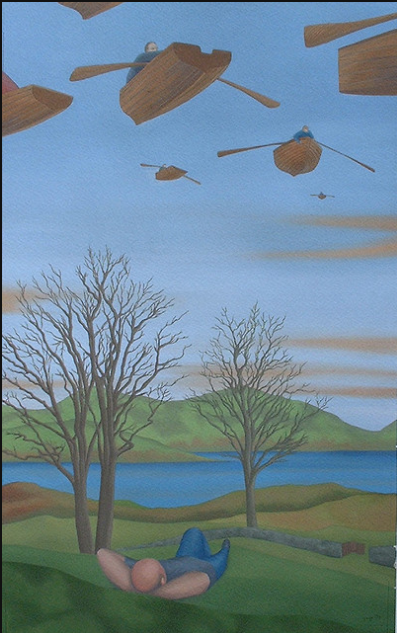
"Rowing Slowly Through Eternity" by Anthea


The dead are always looking down on us, they say.
while we are putting on our shoes or making a sandwich,
they are looking down through the glass bottom boats of heaven
as they row themselves slowly through eternity.
They watch the tops of our heads moving below on earth,
and when we lie down in a field or on a couch,
drugged perhaps by the hum of a long afternoon,
they think we are looking back at them,
which makes them lift their oars and fall silent
and wait, like parents, for us to close our eyes.

That’s good old Billy Collins. The imagery makes me smile. I sometimes wonder about the dead and about the relationship between those who breathe light and those of us who are still inhaling oxygen. Halloween is tomorrow. All Hallows’ Eve. I remember last year seeing a small mass of slightly-older-than-my children running freely and costumed across the grass in a yard in our neighborhood on their way to ask for candy. It was a quintessential scene of childhood. While there’s much that’s unsavory about the way some celebrate the night, there’s so much that can be beautiful about Halloween. Illuminating smiling, carved gourds. Small heroes and princesses, animals and ninjas padding from house to house receiving kindnesses in the form of small edible things.

The holiday has its roots in Samhain, the Gaelic harvest festival which usually takes place on the night directly between the autumnal equinox and the winter solstice, the threshold opening onto the dark half of the year. It is traditionally a night of liminality, in which the veil separating this world from the Otherworld is opened and the dead can visit this mortal sphere. An intermingling of the seen and unseen worlds. I learned this from a humanities professor who specialized in medieval cathedral architecture. The class was called “Framing the Sacred,” an interesting notion, I think. How do you frame the eternal and unbounded in artwork or literature or liturgy? These were the questions we studied. She took our class to the Cathedral of the Madeleine in Salt Lake City one All Saints’ Day. As the choir music rained upon us and raised itself to the stained-glass cherubim circling our heads, I felt the veil thin.

My wife sits at the computer with my eternity-eyed infant daughter in her lap, typing names. Each name is a prayer of sorts—a testimony of Jesus Christ’s infinite, unbounded mercy—and of the role we play in grace. These names, gathered like blueberries from the bushes of old censuses and city records, will be carried with gentle care into holy temples and spoken with affectionate reverence, sweetness on the tongue. Prayers for the dead. “Else what shall they do which are baptized for the dead, if the dead rise not at all?” asked Paul, “Why are they then baptized for the dead?” This in the middle of a discourse on the triumph of life over death, the energetic reality of resurrection: “Death is swallowed up in victory. O death, where is thy sting? O grave, where is thy victory? . . . But thanks be to God, which giveth us the victory through our Lord Jesus Christ. Therefore, my beloved brethren, be ye stedfast, unmoveable, always abounding in the work of the Lord, forasmuch as ye know that your labour is not in vain in the Lord.”

Almost all religions that affirm the eternality of the soul offer prayers in behalf of the dead, to keep them in remembrance, to ask special protective care as they enter that bright unknown. Catholics perform masses and offer prayers for the dead. Jews offer Kaddish—the prayer of making holy. There is a lovely Jewish prayer of mourning, memorial, and obsecration called El Molai Rachamim: “God, filled with mercy, dwelling in the heavens’ heights, bring proper rest beneath the wings of your Shechinah, amid the ranks of the holy and the pure, illuminating like the brilliance of the skies the souls of our beloved and our blameless who went to their eternal place of rest. May You who are the source of mercy shelter them beneath Your wings eternally, and bind their souls among the living, that they may rest in peace. And let us say: Amen.” The Shechinah is the radiant cloud of God’s presence. What a nice place to rest.

Like so many others, members of my church believe perhaps paradoxically that death is not the end of living and that every life matters. Our way of offering prayers for the dead is to perform sacred ordinances on their behalf. We are baptized for the dead, immersed in water in the name of someone who has crossed over the expansive river of death. There is a physicality to the prayer, a heft and a weight. There is a sheer loveliness to it. It is a sanctifying experience to stand in another’s shoes as it were to receive the ordinances of salvation. I often imagine the people whose names are read with such affection sitting near me, or floating above me. Sometimes I imagine them laughing at the prospects and possibility opened up to them through these ordinances. Sometimes I imagine tears of joy and gratitude. Once when I received the ordinances for a long line of men from Italy, I could almost smell the spaghetti and hear their warm, excited voices. Perhaps it is only my imagination. Perhaps not.

Joseph Smith once wrote of the practice, “And now, my dearly beloved brethren and sisters, let me assure you that these are principles in relation to the dead and the living that cannot be lightly passed over, as pertaining to our salvation. For their salvation is necessary and essential to our salvation, as Paul says concerning the fathers—that they without us cannot be made perfect—neither can we without our dead be made perfect.” I’ve thought often about those words “neither can we without our dead be made perfect.” My soft-spoken mission president once told me that “the salvation of a soul always requires the sacrifice of another.” He said that for all humanity, that sacrifice was the Savior, but that each of us is called upon to give of ourselves, to extend ourselves, to offer our time and our energy and our love to bring another to grace. This is what happens in the temple. Christ’s was the great vicarious sacrifice, but unless I become like Him and empty myself out for the blessing and benefit of others, neither I nor they can be saved.

These ordinances take place in temples. The temple is a liminal space, halfway between heaven and earth. What happens there conjoins the worlds. The late, gentle, Swedish Lutheran, Krister Stendahl, who in his lifetime was Dean of Divinity at Harvard University, once said of Mormon temple worship, “In antiquity, . . . the Jerusalem Temple was a place where you went to carry out holy acts, sacrifices and the like. I feel that the Mormon experience of the temple has sort of restored that meaning to the word temple.” Stendahl was a thoughtful, lovely soul. Of baptisms for the dead, which his church does not practice, he said, “It’s a beautiful thing. I could think of myself as taking part in such an act, extending the blessings that have come to me in and through Jesus Christ. That’s a beautiful way of letting the eternal mix into the temporal — which, in a way, is what Christianity is about.” He speaks of “holy envy,” saying if we might speak of such a thing, he has holy envy for the Mormon temple experience. What a nice thing to say.

In September of 1842, Joseph Smith was living in hiding from the infamous Missouri governor Lilburn Boggs, who had it out for the Mormon prophet. He spent much of his time in the space between the rafters and the roof of Edward Hunter’s house in Nauvoo, Illinois. In this setting, he wrote some gorgeous lines about salvation for the dead. Truman Madsen calls it “a rhapsody in an attic.” If poets are the minor prophets, Joseph belongs to both camps, major and minor. Here are his words:

Now, what do we hear in the gospel which we have received? A voice of gladness! A voice of mercy from heaven; and a voice of truth out of the earth; glad tidings for the dead; a voice of gladness for the living and the dead; glad tidings of great joy.

Let your hearts rejoice, and be exceedingly glad. Let the earth break forth into singing. Let the dead speak forth anthems of eternal praise to the King Immanuel, who hath ordained, before the world was, that which would enable us to redeem them out of their prison; for the prisoners shall go free.

 Let the mountains shout for joy, and all ye valleys cry aloud; and all ye seas and dry lands tell the wonders of your Eternal King! And ye rivers, and brooks, and rills, flow down with gladness. Let the woods and all the trees of the field praise the Lord; and ye solid rocks weep for joy! And let the sun, moon, and the morning stars sing together, and let all the sons of God shout for joy! And let the eternal creations declare his name forever and ever! And again I say, how glorious is the voice we hear from heaven, proclaiming in our ears, glory, and salvation, and honor, and immortality, and eternal life; kingdoms, principalities, and powers!

The temple is a house of poetry, of imagery and spirit and symbolism and beauty, like Emily Dickinson’s house of Possibility. It affirms the great mystical connectedness of humanity, of all hallowed ones, all saints, all souls. We matter to each other. This life matters to eternity. I always leave the temple more in love and more appreciative of this dark green living, this golden-bright autumn day.

Saturday, October 13, 2012

Liquids and Vowels

"Father and Child" by Brian Kershisnik


You know what one of my favorite words in the whole world is? Dad. Julie and I watched the movie “Courageous,” and it made me grateful to be a dad. We folded laundry as we watched, and as I was hanging clothes in kids’ closets, Oliver lay curled in his crib sleeping sweetly, Lydia stirred a little and stretched her skinny little heaven arms, and Emerson sat up and looked at me in the dark and said, “Dad?” That word shot electricity through me. I helped him lay back down and covered him with blankets, and I felt so grateful for fatherhood. For my own father, who has never left any doubt about what matters most to him, who has always fathered deliberately. And for Bob, and grandfathers still living and on the other side of the veil. For Heavenly Father. Dad.

I got to take Lydia to her dance class on Monday. She skipped ahead of me, skinny legs in pink tights tucked into white sneakers. She wore her hair in a bun high on her head and a blue hooded sweatshirt with colored hearts on the back. I thought about Lydia, seller of purple, and all the colors this little ballerina peddles—a whole rainbow without charge. Through the window I watched her dance, twirling and leaping like my heart, like David before the ark, like this fluttering bird in my old chest. Dad. What a word.

I love to hear Oliver say “Daddy!” as he toddles slantingly toward me after a day of teaching. He has taken to repeating something I or someone else has said and then following it up with, “Right, Daddy?” That will melt a heart.
This painful, exquisite love I have for these four small people who call me dad is true and salient even if sometimes in their sleep-deprivation-induced, too-much-parade-candy-aggravated mania they scream and scream when they should just be asleep and it makes me want to kick clothing and punch pillows and lock them in their bedrooms crying and weep and weep myself. Especially then, perhaps, this love is real.

Want to know another of my favorite words? Fongyloo. But don’t say it too loudly at our house, at least not near electrical outlets, because that’s where Spiderman’s family lives. And fongyloo is a bad word in Spiderman’s language. This Emerson told me as I tucked him in bed last night. Spiderman used to say it, until he turned three. As Emerson said his nighttime prayer, he prayed, “And please bless JonasJennyBirgithandKjell and NatalieandDevan. And please bless Spiderman that he won’t say ‘fongyloo.’” Afterward he told me that it’s alright to say fongyloo in a prayer. That made me rest easy. When I woke up this morning, I couldn’t remember the word (I really wanted to—you know my fascination with expletives), so I asked, “Hey, Em, what was that word that Spiderman shouldn’t say?” “Do you remember?” he asked. “No,” I said, thinking that he must have also forgotten and now he would just make up another word. “I’d better whisper it in your ear, in case his family is close by,” he said. And he came close and whispered, “Fongyloo.” I laughed. What a memory. What a mind. What a word.

And I love the names of my children. I noticed the other day that the sounds that make up their names are mostly liquids and vowels. Each has three syllables, and the litany of their Christian names drips from the open mouth like praise, like alleluia: Lydia, Emerson, Oliver, Eleanor.

Months or weeks after they came springing, singing into this world, I took each in my arms and gave them a name and a blessing. That experience is reason enough to be a member of a church which believes that discipleship is not a spectator sport. Have I told you that the fact that God gives His priesthood to all of His boys is one of my favorite things about living in the dispensation of the fullness of times? Think about it, the ancient tribe of Ephraim didn’t get to bless their own kids. Most fathers in most churches don’t get the honor. But I do. So rad. So good. As a father, who has had the opportunity to spend a little time with this newly-minted soul in the strict sense (body and spirit), and who cares deeply about its future, I get to take the child in my warm, imperfect hands and pronounce a blessing. It is sacred. One of my favorite things of being a member of the Church. These verses are often in my mind at those times: “The Lord bless thee, and keep thee. The Lord make his face shine upon thee, and be gracious unto thee. The Lord lift up his countenance upon thee, and give thee peace” (Numbers 6:24-26). And this passage from Gilead: “There is a reality in blessing . . . . It doesn’t enhance sacredness, but it acknowledges it, and there is power in that.” To acknowledge the holiness of these bright infants. To hold them in a circle of men with the express desire to pronounce words which will sanctify their existence. I love it.

Julie pointed out the other day that certain aspects of their blessings have foretold defining attributes in their lives. Oliver was blessed with a sense of humor. He has the greatest, quickest grin. He laughs out loud for joy. He tells knock knock jokes with no real punchline, but with astonishing comprehension for a two-year-old, I think. “Not-nok.” “Who’s there?” “Peetga.” “Peetga who?” “Peetga ah ah.” Uproarious laughter. Emerson was blessed to be a peacemaker. This morning as we snuggled in my bed he said, out of the blue and with no antecedent, “Dad, you know why I want to choose two? Because sometimes I want Reese’s Puffs, but Lydia doesn’t like them.” “Are you talking about birthday cereals?” “Yes.” I told him that since his motives were selfless I would consider letting him choose two cereals for his birthday. (A few weeks ago was his birthday and he chose four: Reese’s Puffs, Cinnamon Toast Crunch, Frosted Flakes, and Lucky Charms. I told him from here on out it’s just one, buddy.) Eleanor was blessed to stand in awe of this world. Her eyes are so wide. She opens her mouth to eat the world. She calms in the outdoors. She cranes her head to see things as we pass them. She is, I think, astonished. Julie asked if the blessings bestow these qualities or acknowledge some premortal reality. Perhaps a little of both.

Their names came usually after spending some time with them, with their eyes and their smiles.

Lydia was the name of Julie’s great-grandmother. When she was three, Lydie would say something like this: “My mom is Mommy, and Mommy’s mom is Nana, and Nana’s mom is Gam, and Gam’s mom is me!” We were considering naming her Tuesday. As we stared in wonder at her new face, Lydia felt right in our mouths. Her name has, in addition to liquids and vowels, one small central tap, like in the word “butter.” When she was younger, she took to over-enunciating everything, calling me “datty” and pronouncing her own name “Lytia.” I think the first thing I did after she was born after I almost fainted and then cried was to sing to her. Then I held her and turned to my mother, “There’s no way you love me as much as I love this baby.” “You wouldn’t understand it until this moment, Rob.” The name mostly just means “a woman from Lydia,” but there’s a meaning of “beauty” from questionable etymology. When we named her, I imagined it had something to do with light. “Lover of light,” or something like that. She was always staring at the lights. Lydia was a seller of purple who loved and helped Paul. She worshipped God. A girl “whose heart the Lord opened” so that “she attended unto the things which were spoken of Paul.” She was full of hospitality. She sold a color. She is, in my book, lovely.  

Emerson was named for my wife’s grandfather, in a roundabout sort of way. Julie’s grandpa was an American literature professor. Julie’s dad once asked his dad why he got a PhD in literature. “I was reading Emerson one day and thought to myself, ‘I have a master’s degree in literature, and I can’t understand Emerson.’ So I got a PhD.” That was the way Bri was. He was a deeply engaged and engaging man. He could talk with anyone about anything. He was genuinely interested in life. And so intelligent and so gentle. Bob then asked his dad, “So, now do you understand Emerson.” Bri’s response was quintessential: “You don’t understand Emerson; you experience him.” That is a very Emersonian sentiment. His name is also a shout-out to books and bookishness and writing. He comes from a family of bibliophiles, and he is one himself. Emerson means “son of a good home.” It’s a hopeful name. His middle name is my middle name, my grandfather’s name. A sturdy, usurping name: James.

Oliver was a childhood friend of mine, the good son of good parents. His father was in love with laughter. He had a solid door—oak, probably. It hurt my small hands to knock on it. Was their doorbell broken? Why was I always knocking on that hard door? His mother was Chinese. They invited us to dinner one night and I fear we were far from gracious. There is little sense of others’ feelings in children, at least of adults’ feelings. Oliver and I reconfigured fireworks and invited people to pay money to come to a dazzling show. The first one had surprised us with how well it worked. The grand finale just began to smoke and then flame, like a log, like newspaper. I can’t begin to tell you the disappointment I felt. We rode bikes on dirthills and threw mud balls filled with dog droppings at our neighborhood enemies. There were Olivers in our family tree. Mary Oliver writes lovely poetry sometimes. I think I had been reading her poetry around the time I blessed him:

When it’s over, I want to say: all my life
I was a bride married to amazement.
I was a bridegroom, taking the world into my arms.

When it’s over, I don’t want to wonder
if I have made of my life something particular, and real.
I don’t want to find myself sighing and frightened
or full of argument.

I don’t want to end up simply having visited this world.

That’s a good poem. And all those vowels. The name means “peace” or “kind one.” He has brown eyes, the only one. He also has my face and my wife’s grandfather’s name for his middle name: Willis. There are more stories about all these people than I have time to tell. So many people we love so dearly.

Eleanor is almost all liquids and vowels. She was named for my gentle grandmother, who was at that time dying and who used to give me cinnamon gum when I visited her southern California house. She laughed easily and never scolded. She baked and cooked and fed and nourished. When I held my infant daughter, I would imagine I was holding my own grandmother. It was a strange thought. She was ten pounds, two ounces, and our souls delighted in fatness. Her name means “mercy,” and she has been a tender mercy. She is beginning to roll all over this green earth and to smile a lot and to sleep mostly through the night.

And I roll on, day by day, swimming in the liquids and vowels, in the miracle of dadness. O’s and A’s and E’s and I’s of praise. Beautiful, good home, peaceful, merciful dadness.